

If you are asking whether aftermarket power cables matter, the honest answer from our bench is yes, provided the rest of the system is already sorted, and the gains are largest on power amplifiers and components with hungry supplies. A well made power cable lowers the noise fed into your gear, delivers current with less restriction at dynamic peaks, and replaces moulded connectors that loosen and oxidise over time. What it cannot do is rescue a system with real problems elsewhere, which is why we usually suggest it after speakers and placement are right.
What follows is the guide we give customers across the counter: what the IEC markings on the back of your amplifier actually mean at Australian 240V, where the money goes in a serious cable, and the designs we build every week and can stand behind.
Do power cables really matter?
The sceptical argument runs that kilometres of grid wiring swamp the last metre and a half, and electrically it is half right. The last metre cannot clean up the grid. What it can do is stop making things worse at the exact point where a cable sits between a noisy wall outlet and a sensitive component. Three mechanisms matter.
First, conductor area. A current hungry amplifier draws its power in short bursts at the peaks of the waveform, and thin conductors with higher resistance sag under those peaks. Second, shielding. An unshielded power lead radiates into the signal cables dressed beside it and absorbs hash from the switch mode supplies in every modern house. Third, connectors. The moulded plug on a stock lead is a pressure contact that oxidises and loosens, and through a humid Sydney summer it does both faster than you would expect.
We would not stock these if we could not demonstrate them. Swapping power cables on a resolving system produces changes a room of listeners will pick blind, and they are rarely about brightness or bass quantity. The difference shows up as a quieter background, an amplifier that seems to be working less hard, and loud passages that arrive with ease rather than effort. Source components benefit too, particularly DACs and phono stages, whose low level circuits have the most to lose from a noisy supply.
IEC connectors at Australian 240V
Australia runs a nominal 230V, 50Hz supply, still called 240V by almost everyone, and nearly every hi-fi component takes its power through an IEC inlet. Three families cover almost everything you will meet.
- IEC C13 into C14, rated 10A: the standard three pin socket on most amplifiers, DACs and CD players. At 240V a 10A rating is good for roughly 2,300 watts, comfortably beyond almost any domestic amplifier, so the rating is rarely the limiting factor. The contact quality inside the connector is.
- IEC C15 into C16, rated 10A at 120 degrees: the high temperature variant, identified by a notch opposite the earth pin. It exists for equipment that runs hot, and a C13 plug will not fit a C16 inlet. Some amplifiers and power distribution products specify C15 precisely because it forces the heavier connector.
- IEC C19 into C20, rated 16A: the large rectangular inlet found on serious power amplifiers and conditioners. At 240V that is close to 3,700 watts of headroom, and the contact area inside a C19 is substantially larger than a C13, a real electrical advantage on high current gear.
None of these ratings changes the sound by itself. They matter because they determine which connector bodies are available for your cable, and the serious options, Furutech's FI series and Oyaide's rhodium plated range, are made in all three patterns. When you order from us we fit the pattern your component needs, at the Australian plug end as well as the IEC end, rather than whatever happens to be in the parts bin.
Where a power cable helps most
Not every socket in the rack is equal, and the order we suggest follows the physics. Power amplifiers come first, because they draw the most current and sag the hardest when the supply resists. Integrated amplifiers and receivers are next for the same reason. Source components follow: DACs, CD players and phono stages run tiny signal levels, and what they gain from a better cable is a lower noise floor rather than extra current. Power distribution sits alongside all of this; a well shielded lead into the conditioner or distribution block quiets everything plugged in downstream. Televisions and set top boxes, for the record, are welcome to keep their stock cords.
One myth worth retiring while we are here: a power cable does not need to be the most expensive cable in the system to earn its place, and it will not overshadow weak speakers or a badly treated room. It is the upgrade you make once the fundamentals are right, which is also when it becomes easy to hear.
What you are actually paying for
Strip the jackets off the cables we build and the price differences stop looking mysterious. You are paying for three things, in this order.
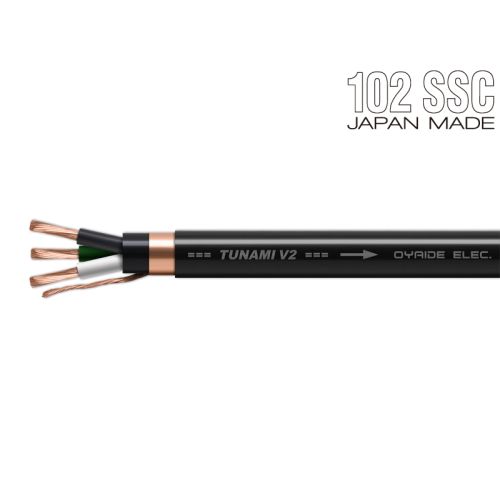
Conductor. Ordinary power flex uses standard electrolytic copper, full of crystal boundaries and microscopic voids. The serious Japanese conductors attack this in different ways. Oyaide's 102SSC is virgin copper, machine peeled to remove surface contamination, then drawn and annealed to a tolerance most cable makers never bother with. PC-Triple C, used by SAEC and Kripton, is forged tens of thousands of times at a fixed angle so the crystal structure aligns along the length of the wire. Both cost real money to produce, and both measure better at the things a power cable is asked to do.
Shielding. A proper audio power cable carries a semiconductor layer to bleed off static, a copper foil or braid against external noise, and often a drain wire to give the shield a clean escape path. The TUNAMI NIGO V2 runs three shield layers plus a dedicated drain. This is invisible once the cable is behind the rack, and audible in a quiet system.
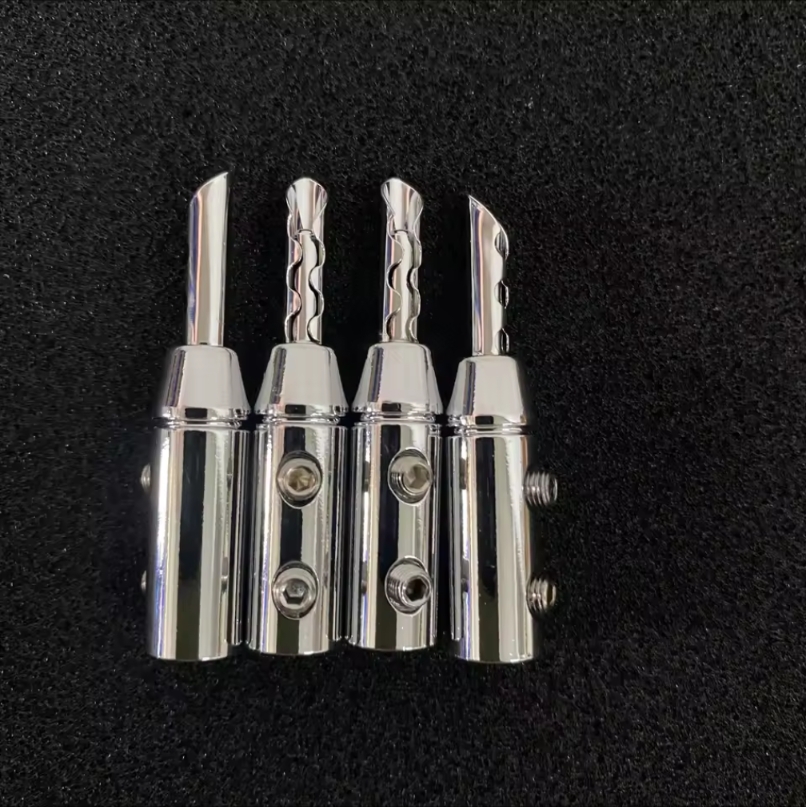
Connectors. Rhodium plated pure copper contacts in machined housings grip harder, conduct better and survive decades of humidity. They are also a significant share of the build cost, and one reason a hand built cable outlasts a drawer full of moulded ones.
Three cables we build and rate
- Oyaide TUNAMI NIGO V2, from $249: 5.5 square millimetres of 102SSC per conductor, roughly 10AWG, rated 600V and 30A, with your choice of C8, C15 or C19 terminations. On a power amplifier it removes a strain you did not know was there. Our default recommendation when current delivery is the priority.
- SAEC AC-6000, from $250, and AC-7000, from $372: the AC-6000 was the first cable in the world built on the PC-Triple C conductor, and the AC-7000 scales the same copper to 5.5sq with a copper foil shield and a damping sheath. The SAEC character is resolution without glare, and source components and integrated amplifiers respond especially well.
- Kripton PC-HR1500M-Triple C, from $485: the top of Kripton's HR range and the most engineering led cable in this catalogue. PC-Triple C throughout, designed for stability of current rather than tonal garnish. If you want to spend once and stop thinking about power, this is where we point you.
Our recommendation
Start at the power amplifier, because that is where current draw and sensitivity to sag are greatest, then move to sources once you have heard what the first change does. Match the connector to the inlet, spend at a level your system can reveal, and be wary of anyone promising a transformation on a two hundred dollar system. The full range, from the entry NEO by Oyaide AXIS-303 at $227 up to the Kripton, lives in our power cables category, every one cut, terminated and tested in our Sydney workshop. Unsure which connector your component takes, or which cable suits it? The custom order form reaches the person who will actually build your cable, and the advice costs nothing.