
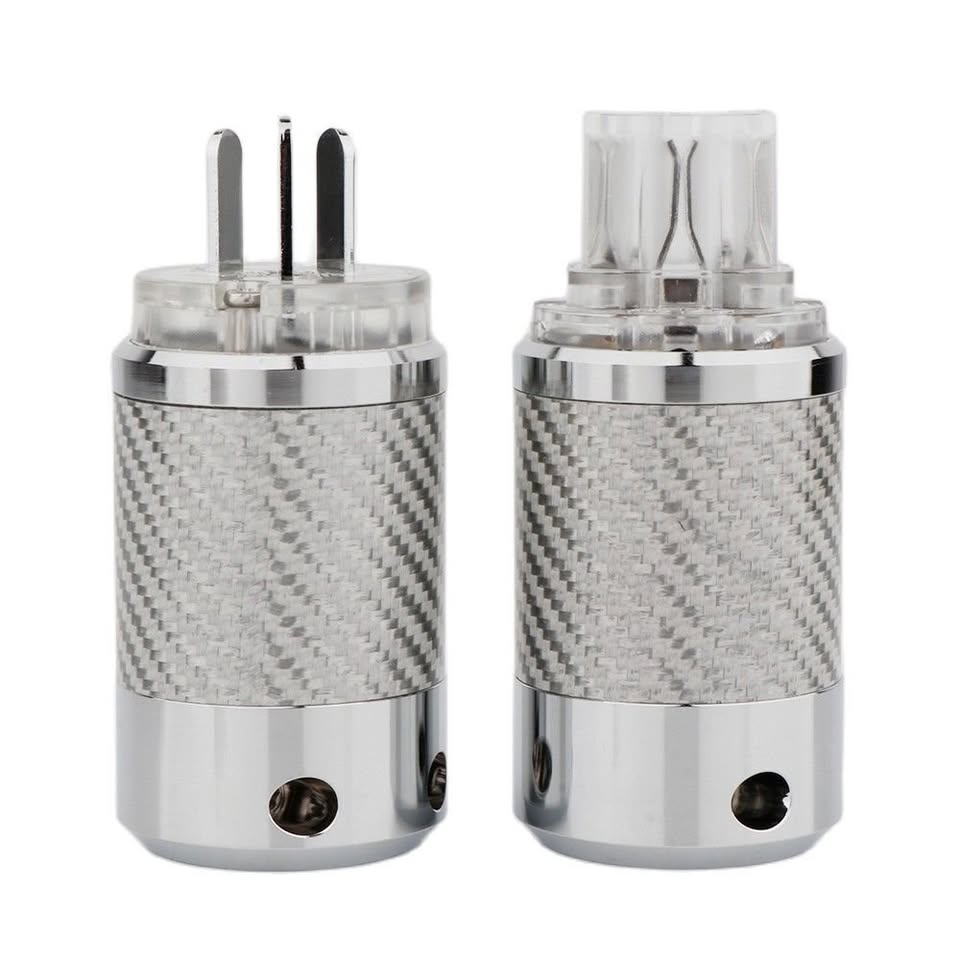
Power cable types confuse everyone the first time, because the back of your amplifier speaks an alphabet of IEC codes nobody explained. The short version for Australian buyers: C13 is the standard three pin socket on most hi-fi, C7 is the two pin figure 8 on small components, C5 is the cloverleaf on laptop supplies, C15 is the notched high temperature variant, and C19 is the big rectangle on serious amplifiers. Each has a defined current and temperature rating, and at our nominal 230V supply the ratings matter less for capacity than for contact quality, which is where an aftermarket cable earns its keep.
How the IEC numbering works
IEC refers to the International Electrotechnical Commission, whose 60320 standard defines the appliance couplers used worldwide. One piece of knowledge untangles most of the confusion: odd numbers name the connector on the cable, even numbers name the inlet on the equipment. So the C13 plug on the end of your power lead mates with the C14 inlet on your amplifier. When someone says their amplifier takes a C13, they are describing the cable end; the socket on the chassis is technically a C14. Every pair below follows the same convention.
C13 and C14: the everyday standard
The C13 and C14 pair is rated at 10A and 70 degrees Celsius, and it covers the vast majority of hi-fi: integrated amplifiers, DACs, CD players, streamers and most power amplifiers of moderate output. At Australia's 230V supply, 10A is roughly 2,300 watts of headroom, so the rating is almost never the constraint in a domestic system. What varies enormously between a moulded stock lead and a hand built one is what the rating does not measure: how much copper is in the contacts, how firmly they grip, and how the plating survives a humid Sydney summer.
C7: the figure 8
The C7 is the small two pin connector shaped like an eight, rated at 2.5A, found on CD players, some streamers, tuners and turntable power supplies. There is no earth pin because the equipment it serves is double insulated. Two notes from the bench. First, C7 leads are treated as disposable, and the moulded ones genuinely are: thin conductors, loose fit, contacts that tarnish within a couple of years. Second, polarity matters more than people expect on a two pin connection, and many listeners hear a consistent difference reversing the plug, a leakage and grounding effect rather than imagination. A properly built C7 lead with real copper is a small, cheap upgrade that small components respond to out of proportion to its price.
C5: the cloverleaf
The C5 and C6 pair is the three pin cloverleaf, also rated at 2.5A, that most people meet on laptop power bricks and compact switch mode supplies. It turns up in hi-fi on small streamers and some powered speakers. There is little aftermarket culture around it because the devices it feeds are usually powered by their own external brick, and the sensible upgrade path there is a better power supply rather than a better lead. If a component you care about uses one, we can still build it properly, but ask us first whether the money would work harder elsewhere.
C15 and C16: the high temperature variant
The C15 connector and C16 inlet carry the same 10A current rating as the C13 pair but are certified to 120 degrees, identified by a notch opposite the earth pin that a C13 cannot clear. They exist for equipment that runs genuinely hot: certain power amplifiers, some power conditioners, and any chassis where the inlet sits near a heat sink. If your component has the notched inlet, the cable needs a C15, full stop, and using a C13 where a C15 belongs is the wrong temperature class for the equipment rather than a tight fit. The serious connector lines, Oyaide's rhodium plated range and Furutech's FI series, both offer the pattern, so specifying it costs nothing in build quality.
C19 and C20: the high current pair
The C19 and C20 are the large rectangular couplers rated at 16A, found on big power amplifiers, power conditioners and distribution blocks. At 230V that is close to 3,700 watts, but the headline number undersells the real advantage: the contact area inside a C19 is substantially larger than a C13, so resistance at the joint is lower and the connection tolerates sustained high current without heating. On an amplifier that pulls hard at dynamic peaks, that larger, firmer interface is worth having. It is why the Oyaide TUNAMI NIGO V2, with 5.5 square millimetres of 102SSC copper per conductor, is offered with C19 termination, and why that combination is the one we build most often for high current amplifiers.
The wall end: AS/NZS 3112
The IEC connector is only half the cable. At the wall, Australian equipment uses the AS/NZS 3112 three pin plug, and the same logic applies there as at the component end: a quality AU plug with plated pure copper pins and a firm cable clamp beats the moulded plug on a stock lead in every way that matters. Every cable we build is terminated at both ends to the same standard, because a serious IEC connector undermined by a bargain wall plug is half an upgrade. One practical note for grey imports and international gear: a cable built with a genuine AU plug is the clean solution, safer and more reliable than running a travel adapter behind the rack indefinitely.
When an aftermarket power cable actually matters
The sceptical argument runs that kilometres of grid wiring swamp the last metre and a half, and electrically it is half right. The last metre cannot clean up the grid. What it can do is stop adding problems at the exact point where the cable sits between a noisy wall outlet and a sensitive component. Three mechanisms matter: conductor area, because a current hungry amplifier draws power in short bursts at the waveform peaks and thin conductors sag under them; shielding, because an unshielded lead radiates into the signal cables dressed beside it; and connectors, because oxidised, loosely gripping contacts add resistance exactly where the current demand is highest.
Be honest about the order of operations, though. A power cable is the upgrade you make once speakers, placement and sources are right, and it will not rescue a system with real problems elsewhere. The components that respond most are power amplifiers first, then integrateds and receivers, then sources such as DACs and phono stages, whose low level circuits have the most to lose from a noisy supply. Our workshop guide to whether power cables matter covers the physics and the listening impressions in full.
What to look for when buying
- The right connector pattern for the inlet: notched means C15, large rectangle means C19, figure 8 means C7, and almost everything else is C13. Check the back panel before you buy anything.
- Real conductor area: look for stated cross-sections in square millimetres. Serious audio power cables run 2 to 5.5 sq mm per conductor; stock flex is often well under 1.
- Proper shielding: a foil or braid screen, ideally with a drain wire, so the cable stops acting as an antenna inside the rack.
- Quality connector bodies: plated pure copper contacts in machined housings, in the pattern your equipment takes, at both ends of the cable.
- A genuine AU wall plug: not an adapter, and not an imported plug forced into local service.
Our recommendation
Identify the inlet, then buy the best connector body and conductor your budget allows in that pattern, starting at the power amplifier where the current draw is greatest. Every build in our power cables category is terminated to order in our Sydney workshop with the pattern your equipment takes, from the entry NEO by Oyaide range up to SAEC's PC-Triple C designs, and connector hardware sits in the DIY category if you are upgrading a chassis inlet at the same time. If you would rather send us a photo of the back panel and have us spec the lot, the custom order form is exactly that conversation.