

Every week someone emails us the same question, give or take: "I have a decent system. I know the cabling matters. I just do not know where to start." This is the guide we send them. It is not a physics lecture and it is not a sales pitch; it is how we actually think about matching Japanese cable to real systems after building hundreds of them.
Start where the signal is weakest
If you take one idea from this guide, take this: cables do their most audible work where the signal is smallest or the current is largest. That means phono first, then interconnects, then speaker cable, then power. A turntable feeding a phono stage through a generic lead is leaving more on the table than any other link in the chain, which is why cables like the Phasemation CC-1200 and Oyaide PA-2075 V2 exist as dedicated designs. If you do not own a turntable, skip ahead; your weakest link is the interconnect between source and amplifier, or the speaker runs.
Match the brand to your taste
Each of our brands has a genuine personality, and choosing between them is more about voicing than hierarchy:
- Oyaide is the engineer's choice: 102SSC copper, scrupulous shielding, and a clean, even balance that never editorialises. Start with the ACROSS 3000 speaker cable or a TUNAMI V2 power cable.
- Zonotone is the romantic: hybrid conductors and a warm, generous tone that flatters bright systems. The 6NSP-Granster 5500a is the classic starting point.
- SAEC is built on PC-Triple C forged copper and sounds like it: coherent, grain free, and even handed. The SPC-650 is the sweet spot.
- Acrolink chases ultimate purity with 7N copper and a fast, crystalline presentation that suits warm, tube flavoured systems. The 7N-S1000 Leggenda is the icon.
- S/A Lab is the underground favourite, and the HIGH END HOSE 3.5 is the cable that made its reputation: neutral, flowing, and very hard to fault.
Spend where it shows
Our honest rule of thumb: put five to ten percent of your system's value into cabling, and put it into the links that matter first. A modest amplifier with good cables will outperform an expensive amplifier choked by freebie wire, but the reverse is also true; cabling cannot rescue a system with a fundamental mismatch. If you are unsure whether your system is ready for the flagship end of the catalogue, ask us. We talk people out of spending too much as often as the opposite, because a well chosen mid-range cable beats an ill matched flagship every time.
Length, terminations and the details that matter
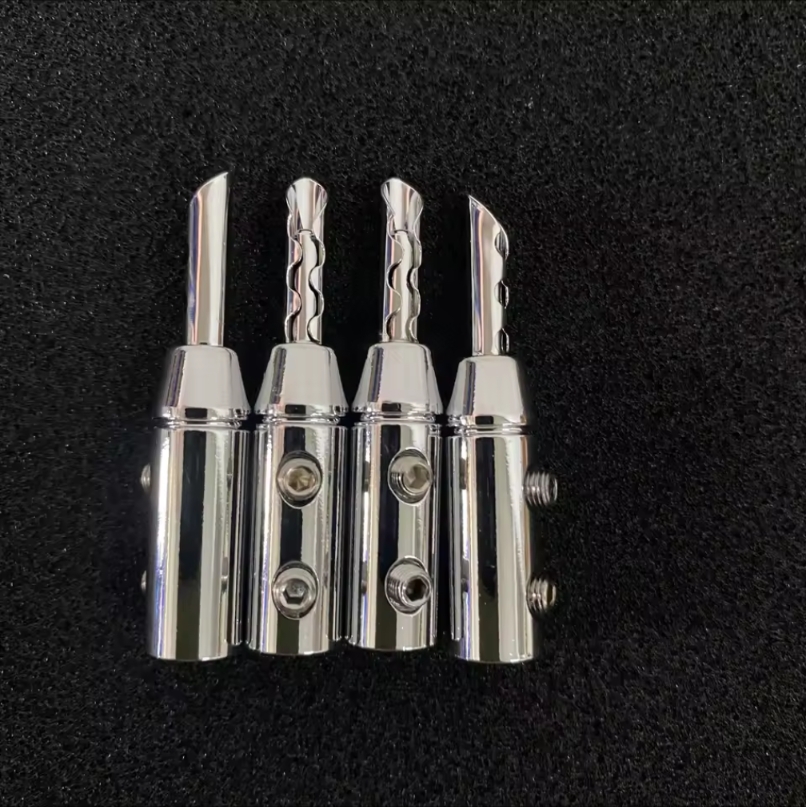
Buy the length you need, not the length on the shelf. Speaker runs should be equal per channel; interconnects should be as short as your rack layout allows; power cables benefit from a little slack rather than tension on the IEC inlet. As for terminations: spades where the binding posts allow them, bananas for convenience, and rhodium plated pure copper for anything you plan to keep. Every cable in our speaker, interconnect, power, digital and phono ranges is built to your exact specification, which is the whole point of buying custom.
The short version
Turntable owners: phono cable first. Everyone else: interconnects, then speaker, then power. Pick the brand whose voicing suits your system, buy the right length, and stop worrying. And if you would rather just describe your system and have us spec the loom, that is literally what the custom order form is for.