

Sixteen gauge speaker cable, 16AWG, is a conductor cross-section of about 1.3 square millimetres, and for the majority of home hi-fi systems it is genuinely enough cable. Into 8 ohm speakers over runs of ten metres or so, a well made 16AWG copper cable gives up nothing you can hear. Thicker wire earns its keep when the runs get long, the speakers get greedy, or the copper turns out to be something else entirely.
What the gauge number actually means
AWG stands for American Wire Gauge, and the scale runs backwards: the smaller the number, the fatter the wire. 16AWG works out to about 1.31 square millimetres of conductor. Step down to 14AWG and you get roughly 2.1 square millimetres; 12AWG is about 3.3. Each three gauge step down more than doubles the cross-section and roughly halves the resistance, and resistance is the whole game. A speaker cable's job is to waste as little of the amplifier's output as possible between the binding posts.
The working rule installers use is the five percent rule: keep the cable's total loop resistance, out and back, under five percent of the speaker's nominal impedance. Into an 8 ohm speaker, that gives 16AWG copper comfortable headroom past ten metres. Into a 4 ohm speaker the budget halves, because the same resistance now eats twice the proportion. This is also why thin cable can soften bass: the amplifier's damping factor, its electrical grip on the woofer, is diluted by every extra fraction of an ohm in the loop.
OFC versus CCA: read the fine print
Not all 16 gauge speaker cable is copper. Much of the cheapest reel stock, especially online, is CCA: copper clad aluminium, an aluminium core wearing a thin copper skin. Aluminium carries only about sixty percent of the current of copper for the same cross-section, so a 16AWG CCA run behaves electrically like something closer to 18AWG copper. The strands are brittle as well, work hardening and snapping after a few tight bends behind a cabinet. The giveaways are light weight, a suspiciously low price, and the words copper clad buried in the small print. Genuine OFC, oxygen free copper, costs a little more and performs exactly like the gauge on the label. Buy real copper.
When 16AWG is genuinely enough
Short to medium runs into friendly loads. If your speakers sit a metre or three from the amplifier, are rated at 8 ohms, and do not dip into the low single digits through the bass, 16AWG OFC is all the cable the job requires. Bookshelf and standmount systems, desktop rigs, second rooms and most surround channels live happily here. Spend the saving on music, or on better made cable rather than thicker cable, which is where the real gains hide.
When to step up to 14 or 12 gauge
Three situations call for more copper. First, long runs: once you pass roughly ten metres each way, particularly in wall or under floor, 14AWG buys back the resistance the distance costs, and 12AWG makes sense past fifteen. Second, low impedance speakers: anything rated at 4 ohms, or with a reputation for dipping lower, halves your resistance budget, so step up a gauge or two to compensate. Third, big amplifiers working hard: high current delivery through a skinny cable is headroom you already paid for, thrown away as heat. It is the same arithmetic electricians use, applied to a smaller canvas.
Where engineered cable fits in
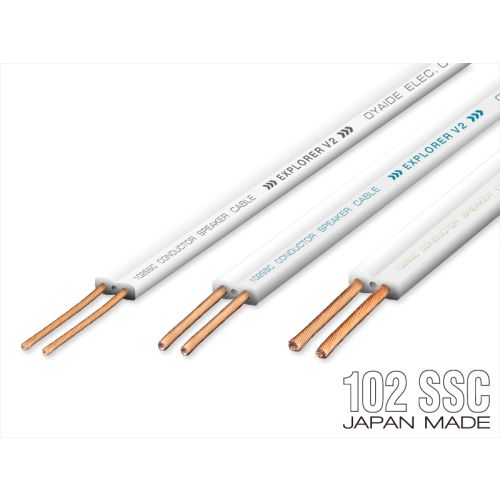
Here is the part the gauge debate usually misses. Cross-section sets the electrical floor, yet conductor quality and geometry decide what happens above it. The SAEC SPC-650, from $157, uses 1.4 square millimetre conductors, right in the 16AWG class, but they are PC-Triple C copper, forged so the crystal structure aligns along the wire, and the gain in ease and freedom from grain is audible on any decent system. The SAEC SPC-350, from $127, packs the same conductor technology into a slimmer build for shorter runs and smaller speakers. And the Oyaide EXPLORER V2, from $99, shows the other side of the ledger: a modest 0.75 square millimetres of Oyaide's 102SSC copper that outperforms generic wire twice its size, because geometry and metallurgy do work that bulk cannot.
Put simply: buy the gauge the run and the load demand, then spend whatever is left on better copper rather than more copper. A properly made cable in the 16AWG class will outperform a fat, cheap one in almost every system we have demonstrated.
Our recommendation
Runs under ten metres into 8 ohm speakers: 16AWG is enough, so spend on quality. Longer runs or 4 ohm loads: step up to 14 or 12 gauge, or choose an engineered cable with a generous cross-section. Every cable in our speaker cables range is cut to your exact length and terminated by hand in our Sydney workshop, so you buy the metres your room needs and nothing more. If you would rather describe the system and have us spec the gauge and the cable in one answer, the custom order form is exactly that conversation.